
The license outcome was set by the conversion path chosen rather than by the technical move, and brownfield carried 20 to 40 percent of legacy entitlement that no longer mapped
Five paths are five commercial outcomes wearing one technical decision. The path is chosen long before anybody prices it.
Prepared by Redress Compliance · August 19, 2026 · SAP S/4HANA migrations. 30 to 40 migrations advised, 2024 to 2025.
Executive summary
Brownfield conversions carried 20 to 40 percent of legacy entitlement that no longer mapped to an active need. The technical path preserved a commercial position nobody re examined.
Contract conversion repriced shelfware that a greenfield reset would have dropped. Converting the whole contract converts the parts you stopped using too.
Subscription proposals bundled migration credits that masked a 10 to 20 percent uplift on the steady state subscription. The credit is one year; the uplift is every year.
The conversion credit applies at contract execution, not at go live. Sign early and you carry the new support base before the new licenses are deployed.
What are the five paths, commercially?
Five formal paths exist, and each carries its own commercial structure rather than just its own technical sequence. The buyer needs the matrix before the vendor opens the conversation.
| Path | Cost band | Risk profile | Leverage profile |
|---|---|---|---|
| Brownfield conversion | Medium | Lower technical risk | Medium to high |
| Greenfield re implementation | High | Higher technical risk | High |
| Selective data transition | Medium to high | Module dependent risk | High |
| Subscription private edition | Variable subscription | Operational simplicity | Low |
| On premise deployment | Medium to high | Self managed | High |
The subscription path is the lowest leverage one
It is the only path that surrenders the perpetual license rights. The other four preserve them, which is the asset every later negotiation is argued against.
The undersold path
Selective data transition is the hybrid, with module by module redesign and a discrete license adjustment. It is rarely recommended and it is where the buyer side value usually sits. The product scope is on the S/4HANA page and the subscription model on the RISE page.
How does the conversion math actually work?
Three conversion models, each with a different credit calculation and a different commercial consequence for what you end up holding.
- Product conversion: existing products map to equivalents at a defined ratio, with net new functionality priced separately.
- Contract conversion: the entire contract converts to a new one on a fresh price schedule.
- Subscription substitution: perpetual licenses retire in favour of the subscription, with no conversion math and no perpetual residual.
The conversion credit trap
The credit applies at the moment of contract execution, not at go live. Sign the conversion before the migration completes and you carry the new support base on the new licenses, often long before those licenses are deployed.
Buyers do refuse. One manufacturer walked away from the subscription proposal entirely and rebuilt the position on the perpetual paths, which is documented in that negotiation record.
Push the conversion event to go live
The buyer side discipline is a phased license activation aligned to migration milestones rather than to the signature date. That single move changes when the support base starts running.
The SAP conversion and migration reference
The five paths, the three conversion models, the credit mechanics and the buyer side moves across the estate.
Get the brief →What 30 to 40 SAP S/4HANA migrations showed
Across roughly 30 to 40 SAP S/4HANA migrations Fredrik Filipsson advised between 2024 and 2025, the license outcome was set by the conversion path chosen, not by the technical move itself. Three patterns recur.
- Brownfield conversions carried 20 to 40 percent of legacy entitlement that no longer mapped to an active S/4HANA need.
- Contract conversion on the product conversion model repriced shelfware that a greenfield reset would have dropped.
- Subscription proposals bundled migration credits that masked a 10 to 20 percent uplift on the steady state subscription.
A technical decision made by the platform team sets a commercial position the procurement team then negotiates against for a decade.
- Every risky clause flagged with the verbatim quote and page anchor
- Entitlements, caps and protections verified across your whole contract portfolio
- Scenario simulation before the call: test alternative terms and see the financial impact of each
What does each path cost across five years?
Three lines carry it: the license conversion, the implementation services, and the running support. Each path sits differently across all three.
| Path | License line | Services line | Five year total |
|---|---|---|---|
| Brownfield, mid size | $4.2M | $8.5M | $22.1M |
| Greenfield, mid size | $6.8M | $18.3M | $36.8M |
| Selective, mid size | $5.1M | $12.7M | $28.4M |
| Subscription, mid size | n/a | $6.2M | $33.2M |
| On premise, mid size | $5.4M | $11.2M | $25.6M |
The cheapest services line is not the cheapest path
The subscription path carries the lowest implementation line and one of the highest five year totals, because the running line replaces the license line permanently rather than once.
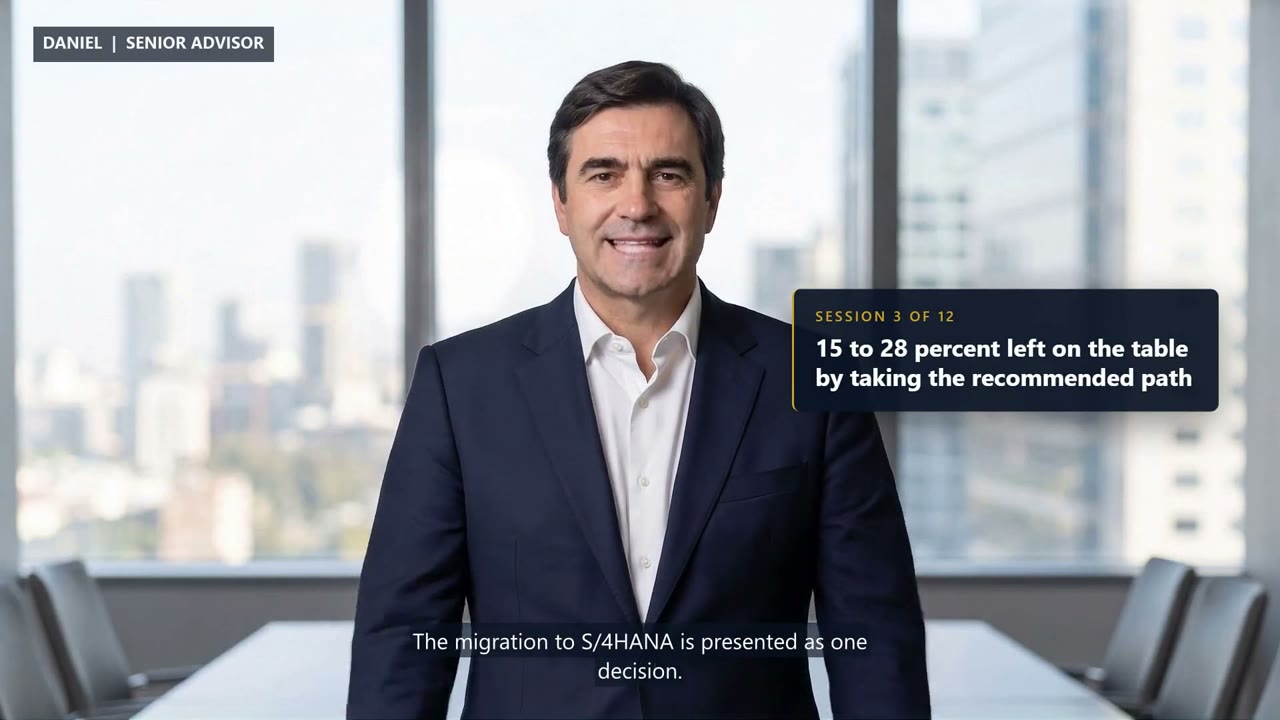 Watch the briefing · 4:41Five Paths, Five Different BillsFive commercial outcomes rather than one technical decision, and what anchoring on the recommended path costs.
Which entitlement should survive the move?
Only the part that maps to something running. Brownfield preserves the rest by default, which is why the path choice is a licensing decision rather than a technical convenience.
Roughly four in ten moves take the brownfield path
It is the most common route and the lowest technical risk, and it is also the one that carries dead entitlement forward unless somebody deliberately drops it during the conversion.
The access metric that arrives alongside
Document based access charging is a separate meter that lands with the move, set out on the digital access page, with the wider terms on the licensing trust centre. The estate view sits in the S/4HANA licensing reference.
Where the common advice on the migration is wrong
The common advice is to pick the path on technical risk and negotiate the license afterwards. We disagree.
The path is the negotiation
Brownfield conversions carried 20 to 40 percent of legacy entitlement that no longer mapped, and contract conversion repriced shelfware a greenfield reset would have dropped. Both outcomes were fixed by the path before pricing began.
The buyer side move is to model the license outcome of all five paths before the technical recommendation lands, and to push the conversion event to go live. The wave planning sits in the migration series and the advisory scope in the S/4HANA advisory service.
What the migrations measured, 2024 to 2025
Two cuts of the engagement file, both about what the path carried rather than what the discount removed.
Mapping to no active need in the target system, preserved by the conversion rather than examined during it.
Where migration credits bundled into a subscription proposal covered the first year and the higher run rate persisted after it.
Neither is visible in the technical business case. Both are permanent once the path is signed.
Your first five moves
- Model the license outcome of all five paths before the technical recommendation lands, because the path sets the commercial position and the pricing follows it.
- Map every legacy entitlement to something actually running in the target, since brownfield carried 20 to 40 percent that no longer mapped to any need.
- Read the migration credit against the steady state rate, because a one year credit masked a 10 to 20 percent uplift that applies every year after it.
- Push the conversion event to go live rather than to signature, so the new support base does not start running on licenses nobody has deployed yet.
- Price the selective path even if nobody recommends it. The SAP practice and the total cost calculator run the five path comparison before the proposal arrives.
Frequently asked questions
What sets the license outcome?
The conversion path chosen, not the technical move itself. Five paths produce five different commercial positions from the same starting estate.
How much dead entitlement does brownfield carry?
Between 20 and 40 percent of legacy entitlement that no longer mapped to an active need in the target system, preserved by default rather than examined.
What are the three conversion models?
Product conversion at a defined ratio, contract conversion onto a fresh price schedule, and subscription substitution which retires the perpetual rights entirely.
What is the conversion credit trap?
The credit applies at contract execution rather than at go live, so signing early means carrying the new support base before the new licenses are deployed.
How is that fixed?
By negotiating a phased license activation aligned to migration milestones instead of to the signature date, which moves when the support base starts running.
Do migration credits actually save money?
They cover the first year. In the reviewed proposals they masked a 10 to 20 percent uplift on the steady state subscription that applies every year after that.
Which path has the least leverage?
The subscription path, because it is the only one that surrenders the perpetual license rights. The other four preserve the asset later negotiations argue from.
Which path is undersold?
Selective data transition. It is the hybrid with module by module redesign and a discrete license adjustment, and it is rarely the recommended option.
Is the cheapest services line the cheapest path?
No. The subscription path carries the lowest implementation line and one of the highest five year totals, because the running line replaces the license line permanently.
When should the path be modelled?
Before the technical recommendation lands. Once the path is chosen the commercial outcome is largely fixed, and the pricing conversation happens inside it.
