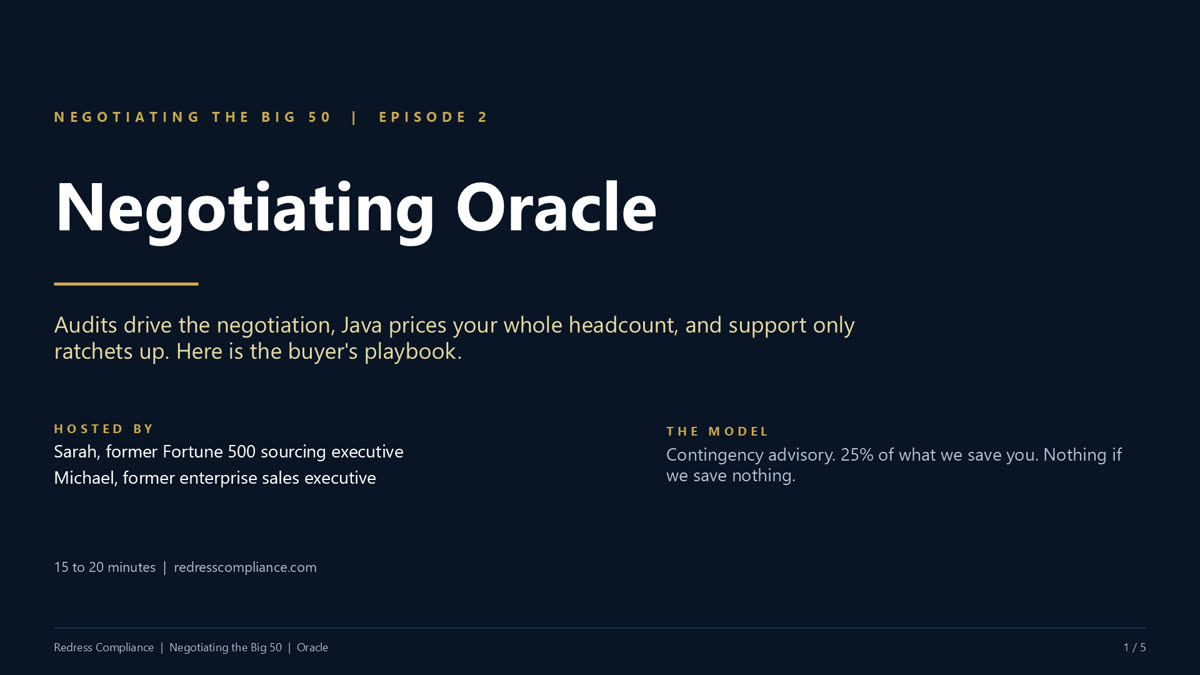
The OCI discount ladder is close to arithmetic, so the negotiation is really about the commitment you can honestly consume. A seventeen minute session on the tiers, Support Rewards, competitive leverage, why buying more Oracle weakens your position, and the credit mechanics that decide your effective rate.
The first three minutes are open to everyone. Tell us who you are and the rest plays straight away, no approval, no waiting.
We have your details. If the video does not resume, refresh the page and it will pick up where you left off.
Unlike most enterprise software, the OCI discount structure is not mysterious. It moves in steps with the size of your annual commitment, roughly five, ten, fifteen and twenty percent, with the twenty percent tier sitting around five million dollars a year of committed spend. Which means the negotiation is not really about the percentage at all. It is about the commitment, and a bigger discount on capacity you cannot consume is a more efficient way to waste money.
That matters because across the Oracle cloud engagements we have advised, annual flex commitments overshot real usage by twenty to forty percent, with the surplus expiring quietly at term end. A customer who pushed to the top tier and then used two thirds of the commitment paid more per unit consumed than one who committed honestly at a lower tier. Your effective rate is what you paid divided by what you used, and almost every negotiation you will read about aims at the numerator.
The session also covers Support Rewards, which reduces the on premises support bill in proportion to OCI consumption and is routinely left unclaimed because nobody asks; where to build genuine competitive leverage, which is on the non database workloads where the other hyperscalers are straightforwardly competitive rather than on the database estate where Oracle knows the answer; why adding Oracle products buys dependency rather than leverage; and the Universal Credits mechanics that decide whether the recommit is a negotiation or an acceptance.
Every line jumps the player to that point.
The model. Redress Compliance works on contingency. You negotiate with the vendor first. When you have gotten everything you can get, bring the deal to Redress and we take 25 percent of what we save you beyond your best number. Nothing saved, nothing paid. Talk to us.
New sessions, new vendor briefings, and the buyer side analysis behind them. One email, no vendor marketing, unsubscribe in a click.