
A timely non renewal notice moved the final discount 8 to 18 percent
Automatic renewal is not unusual and not unfair. The asymmetry is that the vendor benefits when you forget, and the buyer benefits only when the renewal is treated as an active event with a date somebody owns.
Prepared by Redress Compliance · August 15, 2026 · Salesforce advisory. Based on 110 to 140 benchmarked Salesforce renewals, 2024 to 2025.
Executive summary
The notice is a lever, not a threat. Filing a timely non renewal notice moved the final discount by 8 to 18 percent against accounts that let the term roll.
Half the accounts had no owner. In roughly half, nobody owned the renewal calendar, and the notice window was discovered with under 45 days to spare.
The escalator runs before the negotiation. Contracted uplift clauses added 7 to 12 percent to the base before anyone opened a conversation.
Silence is consent. The order form renews for a new term, usually equal to the last one, carrying the existing products and any contracted increase.
The buyer side clock starts 12 to 18 months out, because the notice is the last gate rather than the beginning of the work.
What the clause does, and where it lives
| Element | How it works | What to check |
|---|---|---|
| Renewal trigger | Silence renews the term automatically | Whether the term is fixed length or evergreen |
| Notice window | Commonly 30 to 90 days before term end | The exact end date on every active order form |
| Uplift clause | Raises the renewal price by a set percentage | Whether a cap exists, and what it is written against |
| Precedence | The order form usually overrides the master agreement | Which document governs when the two conflict |
Fixed term and evergreen fail differently. A fixed term clause rolls into another defined period, commonly 12 or 36 months, so a missed notice can lock you for years rather than months. An evergreen clause rolls in shorter increments, which makes it easier to exit and easier to ignore. Large Salesforce deals are more commonly fixed term, which is exactly the case where the cost of missing the window is highest. Pull every active order form and read the renewal and notice language line by line, because the precedence clause decides which version applies.
Taking the automatic out of automatic
- Record the exact term end date from each order form, then subtract the notice period to produce an internal deadline.
- Set the internal alert 60 days ahead of that deadline, so the decision is made with room rather than under pressure.
- Assign one named owner for the renewal calendar, because in half the accounts we reviewed nobody held it.
- Cap the escalator at signature, as a fixed maximum uplift in the order form or a renewal price hold for a defined term.
- Consider co termination where products grow together and scattered end dates keep triggering silent rollovers, per the 2026 cost brief.
- Build the anchor from usage data rather than reacting to the vendor proposal, which is the work the notice window exists to protect.
The Salesforce renewal negotiation playbook
Auto renewal defense, the notice calendar, discount benchmarks, escalator caps, and the buyer side moves across the estate.
Get the playbook →A procedural step that people treat as a declaration
The standard advice is never to file a non renewal notice unless you intend to leave, because it sours the relationship. Across the renewals we have run, a timely notice is a routine procedural step that preserves the right to negotiate, and it moved the final discount by 8 to 18 percent compared with accounts that let the term roll. The relationship survived in every case, because nothing about the notice says you are leaving.
The confusion is understandable and expensive. A notice reads like a decision, so it gets escalated as one, and executives who have no intention of switching platforms decline to send something that looks like a threat. Meanwhile the alternative, saying nothing, is treated as neutral when it is actually a choice with a price: the term renews on the vendor's terms, carrying the contracted uplift, with no obligation on anyone to reopen the number. Silence is not the safe option. It is the option that costs 7 to 12 percent before anyone has spoken.
Underneath sits an ownership problem rather than a contractual one. In roughly half the accounts we benchmarked, nobody owned the renewal calendar, and the window surfaced with under 45 days left. At that point the work that produces a defensible position, counting utilization, assembling the anchor, testing an alternative, cannot be done, so the buyer negotiates against a proposal instead of a position. The clause did not cause that. A missing owner did, and the clause simply converted the omission into money.
Which is why the real clock starts 12 to 18 months out. The notice window is the last procedural gate in a process that should already be well advanced by the time it arrives: the escalator capped at the previous signature, the usage evidence assembled, the end dates aligned or deliberately staggered. Do that and the notice becomes what it actually is, a calendar item that keeps the negotiation open. Leave it, and the most consequential clause in the agreement gets exercised by default. The discount bands sit in the benchmark brief, the cost stack in the hidden costs brief, and the wider library in the Salesforce practice.
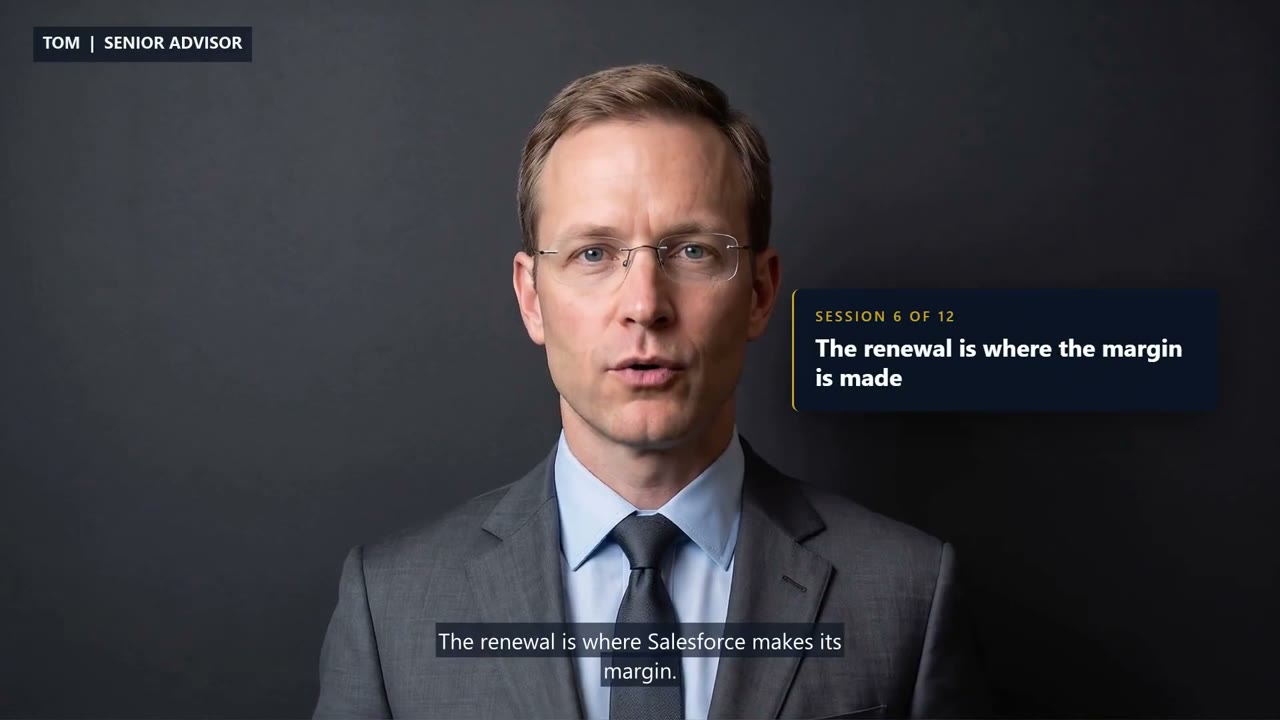 Watch the briefing · 4:31The Renewal: What Moves and What Does NotWhich parts of a Salesforce renewal are genuinely negotiable, which are structural, and where the buyer side time is best spent.
- Every risky clause flagged with the exact quote, the page, and the replacement language
- Renewal uplift exposure modeled over the full term, with the cap to ask for
- A negotiation playbook, talking points, and a two page executive brief on day one
The notice clock, counted backward
Own the calendar
One named owner, every order form end date recorded, and the notice period subtracted to produce internal deadlines.
Build the anchor
Utilization counted, the cost stack modeled, and a defensible position assembled before any vendor proposal arrives.
A calendar item
File inside the window as a procedural step that keeps the negotiation open, weeks before the deadline rather than on it.
What the renewal file shows
Across roughly 110 to 140 Salesforce renewals benchmarked in 2024 and 2025, the auto renewal clause was the single most common reason buyers lost leverage:
Against accounts that let the term roll, achieved without any of them leaving the platform.
Applied to the base before a negotiation opened, and running off your negotiated rate rather than list.
The patterns: no named owner for the calendar, the window found with under 45 days left, and the escalator inherited rather than capped.
The buyer side move is to make the notice a calendar item. The wider library sits in the Salesforce practice.
Your first five moves
- Pull every active order form and record the exact term end date and notice period from each.
- Subtract the notice period and set an internal alert 60 days earlier, then assign one named owner.
- Check whether an uplift cap exists, and if not, put one on the list for this signature rather than the next.
- Decide co termination deliberately, aligning end dates where products grow together and separating anything you may drop.
- Build the anchor from usage data 12 to 18 months out. The Salesforce practice runs the calendar with you.
Frequently asked questions
What does the Salesforce auto renewal clause do?
It renews your subscription for a new term, usually equal in length to the prior one, unless you give written notice not to renew. Silence is consent, and the renewal carries the existing products plus any contracted price change. The order form term usually overrides the master agreement default.
How long is the notice window?
Commonly 30 to 90 days before the term end, and it is a hard gate: outside it a notice is either too early to count or too late to stop the roll. Find the term end date on each order form, subtract the notice period, and treat the result as an internal deadline to act well before.
Is filing a non renewal notice a hostile act?
No. It is a procedural step that preserves your right to negotiate rather than a decision to leave. Across the renewals we have run, a timely notice moved the final discount by 8 to 18 percent compared with accounts that let the term roll, and the relationship survived in every case.
How big is the contracted uplift?
Contracted uplift clauses added 7 to 12 percent to the base before any negotiation began in the renewals we benchmarked. The escalator runs off your negotiated rate rather than list, which is why protecting that rate matters more than the headline list price.
Can the escalator be capped?
Yes, and it is far cheaper to win at first signing than at renewal. The cleanest form is a fixed maximum uplift written into the order form. The next best is a renewal price hold for a defined term. Both require time, usage data and a credible alternative to secure.
What is the difference between fixed term and evergreen renewal?
A fixed term clause rolls into another defined period, commonly 12 or 36 months, so a missed notice can lock you for years. An evergreen clause rolls in shorter increments, which is easier to exit and easier to ignore. Large Salesforce deals are more commonly fixed term.
Should you co terminate the estate?
It helps when products are growing together and scattered end dates keep triggering silent rollovers, because it converts a scatter of small renewals into one leverage event. It hurts when you plan to drop a product, since co terming can lock it in alongside everything else.
When does the buyer side clock actually start?
Twelve to eighteen months out, not at the notice deadline. The notice is the last procedural gate rather than the beginning of the work, and a renewal anchor built from usage data takes months to assemble. Discovering the window with 45 days left means negotiating without one.
The Renewal: What Moves and What Does Not
Session 6 of the Salesforce Negotiation Series. What is genuinely negotiable at a Salesforce renewal, what is theater, the 180 to 240 day runbook, and how to answer the reprice threat when your discount supposedly expires with the term.
